For event production teams, the challenge is rarely just capturing the content. It is capturing it reliably, across different rooms, with limited crew, unpredictable venues, tight turnaround times, and equipment that needs to travel easily.
For Chemical Watch, that challenge was part of daily life.
The company runs professional events and conferences focused on chemical regulation, producing sessions that often need to be captured, streamed, edited, and delivered after the event. When Luke joined the company, it was simple but time-consuming: two cameras, no connection between them, SD card recording, and hours of footage to sync and edit afterwards.
“It was two video cameras, not connected at all, recording to SD cards on opposite sides of the room,” explains Luke Hayes, Technical Production Lead at Chemical Watch Events & Training. “My job was primarily to edit those videos.”
As the number and scale of events grew, that workflow quickly became difficult to sustain. Multi-camera conference recordings meant long hours in post-production, with turnaround times that could stretch to two weeks. The team needed a better way to work.
They first moved toward live switching with Blackmagic Studio Cameras and ATEM workflows, recording the switched output locally instead of building every edit afterwards. That helped, but it did not solve the next problem: scale.
“As our events scaled up, it went from having the cameras next to us, where we could just reach over and move them around, to needing different angles and putting tripods elsewhere,” says Hayes. “Then it was time for PTZs.”
That is where BirdDog X1 entered the workflow.
The PTZ Turning Point.
The reason for moving to PTZ was simple: Chemical Watch Events & Training needed to cover more rooms and more streams without adding more people.
For multi-room conference production, traditional camera setups quickly become heavy. More cameras usually mean more tripods, more operators, more cabling, more power, more baggage, and more time. But with BirdDog X1, the team could run a compact PTZ setup that was easier to deploy, easier to control, and better suited to the way they work on site.
Today, a typical Chemical Watch Events & Training conference room setup uses three BirdDog X1 cameras, connected over NDI through a PoE switch, with production handled in vMix and control supported by Stream Deck and Companion. The result is a setup that is powerful enough for professional event coverage, but light enough for a small crew to manage.
“We went from maybe a two-week turnaround with full-time editing afterwards to doing multiple streams simultaneously in different rooms with one AV tech, one audio tech, and the edit is maybe two hours work,” says Hayes.
That shift changed the way the team works.
Instead of spending days rebuilding sessions after the event, they can now produce much of the final output live. Instead of adding more staff for every room, they can run more efficient conference workflows with a smaller footprint. And instead of treating post-production as the main job, the focus moves back to delivering the event.
One Cable Changed Everything.
A major part of that transformation is NDI.
For Chemical Watch Events & Training, the benefit of IP video is not theoretical. It is practical. The cameras are connected over the network, powered by PoE, and controlled through the same infrastructure. In a hotel, conference center, or temporary event space, that simplicity matters.
The team runs the X1 cameras into a PoE switch, then into a router that can connect to the venue network or hotel internet depending on the setup. “Everything is PoE,” says Hayes. “It’s fantastic.”
For teams still hesitant about moving to IP video, his experience is reassuring. There is a learning curve, but not an impossible one.
“NDI has been really good. It was a bit of a learning curve to begin with,” he says. “A little bit of troubleshooting, and a bit of will to learn it. That’s all you need.”
And once the workflow is in place, going back is hard to imagine.
“I think we’ll always be NDI,” he adds. “It’s just so much easier having that one cable run on site.”
For conference production, that single cable can replace a lot of complexity. Instead of running separate power, video, and control lines, the team can simplify the setup and reduce friction on site.
Lightweight Enough for the Road.
Conference production does not just happen in one place. It travels.
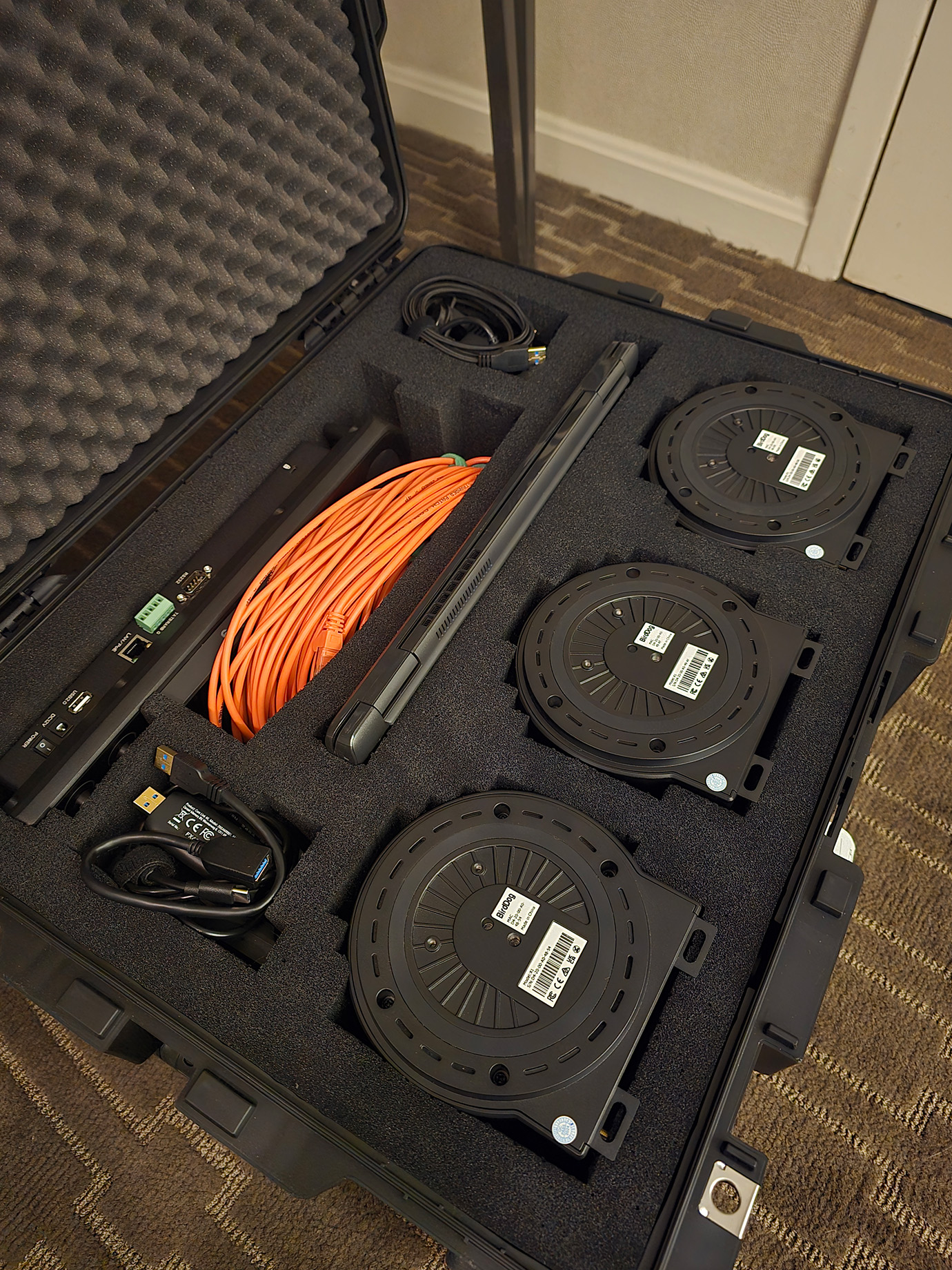
That made the size and weight of the BirdDog X1 setup especially important for Chemical Watch Events & Training. The team built a travel kit around the cameras, and the result is a compact production system that can move from event to event without becoming a logistical problem.
“I fit three BirdDog X1s, the new KBD, a Dell laptop, the PoE switch, router, Stream Deck, and the Peli case itself, all under 20 kilos,” says Hayes.
For travelling AV teams, that detail matters.
Previously, the team had used Blackmagic Studio Camera 4Ks. With only two cameras, plus the ATEM Mini and laptop, the kit could reach around 24 or 25 kilos. At that point, travel becomes more difficult and baggage costs become a real consideration.
With the BirdDog X1 setup, Chemical Watch Events & Training can take more cameras, more control, and more flexibility in a lighter package.
“Portability is not just a convenience for us. Travelling with our previous kit was so demanding that it caused a back injury. This setup lets us travel lighter, work faster, and get on with the job. says Hayes.
The Small Detail Everyone Notices.
While the workflow transformation is the heart of the story, one BirdDog feature gets mentioned at almost every event: Halo Tally.
BirdDog’s Halo Tally system gives presenters, operators, and people in the room a clear visual indication of which camera is live. For the Chemical Watch Events & Training team, it seemed like a small detail at first. But in real conference environments, it quickly became something people noticed.
“One comment I get all the time is the tally on the BirdDog,” says Hayes. “Everybody says how good it is and how easy it is.”
That visibility is especially useful when working with vMix and live-switched conference sessions. It helps presenters understand where attention is focused, gives the production team a clearer workflow, and makes the setup feel more professional to people in the room.
“I didn’t think it was such a big deal,” he adds. “But every conference, people say it’s really easy to see.”
Scaling Production Without Scaling Complexity.
The result for Chemical Watch Events & Training is a conference production workflow that is faster, lighter, and easier to scale.
BirdDog X1 allows the team to cover rooms with multiple camera angles, control cameras remotely with KBD or other devices, simplify cabling with NDI and PoE, integrate with vMix, Stream Deck, and Companion, and dramatically reduce the amount of editing needed after the event.
For a small team, that is the real value.
It is not about adding more technology for the sake of it. It is about building a workflow that lets fewer people do more, without compromising the quality or reliability of the production.
For Chemical Watch Events & Training, the move to BirdDog X1 has helped turn conference video from a slow post-production task into a live, efficient, repeatable workflow.
From two weeks of editing to two hours.
That is the difference.